4000K vs 6500K: A Complete Guide to LED Color Temperature
Color Temperature Guide
You’re choosing between 4000K and 6500K lighting for your project. The wrong color temperature can make relaxation spaces feel tense, focus hard to sustain, and productivity drop. This guide breaks down the real differences between neutral and cool daylight, shows you exactly which fits each application, and gives you a practical framework to decide with confidence.

What Is LED Color Temperature and Why Does It Matter?
What Is Color Temperature (Kelvin)? A More Intuitive Way to Understand It
The unit of color temperature is Kelvin. The easiest way to grasp it? Look at daylight.
| Color Temperature | Daylight Time | Light Character & Signal |
|---|---|---|
| 2700–3000K | Sunrise (6:00 am) | Warm, golden, relaxing |
| 4000K | Late Morning (9:00 am) | Balanced, neutral, naturally focused |
| 6500K | High Noon (12:00 pm) | Crisp, intense, cool, and alerting |

How Spectral Balance Defines 4000K and 6500K
Here is the objective data from our three 22W LED test reports. By comparing these critical parameters, we can reveal the exact performance of each light source.
1. 3000K (Red Dominant): The graph shows that most of the energy is heavily concentrated in the red‑orange band on the right. This creates a very warm light, but it also looks noticeably yellowish. Ideal for living rooms, bedrooms, and upscale restaurants where a relaxed atmosphere is key.
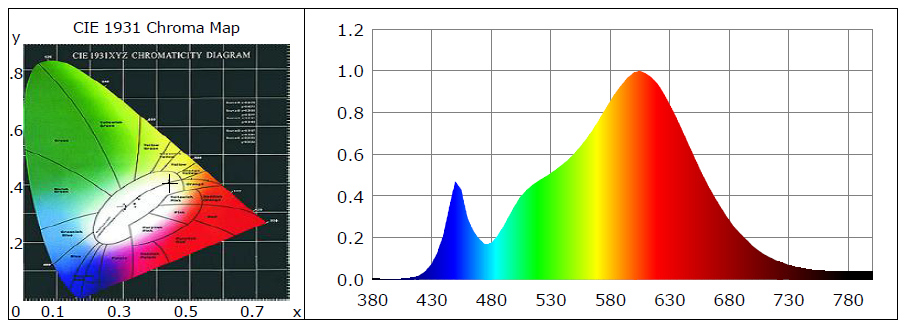

2. 4000K (The Perfect Balance of Red and Blue): From the chart, we can see that the peak energy levels in the blue wavelength and the red‑orange wavelength are remarkably close in height. This balanced spectrum is ideal for modern offices, high‑end retail stores, art galleries, and everyday business environments requiring prolonged concentration.
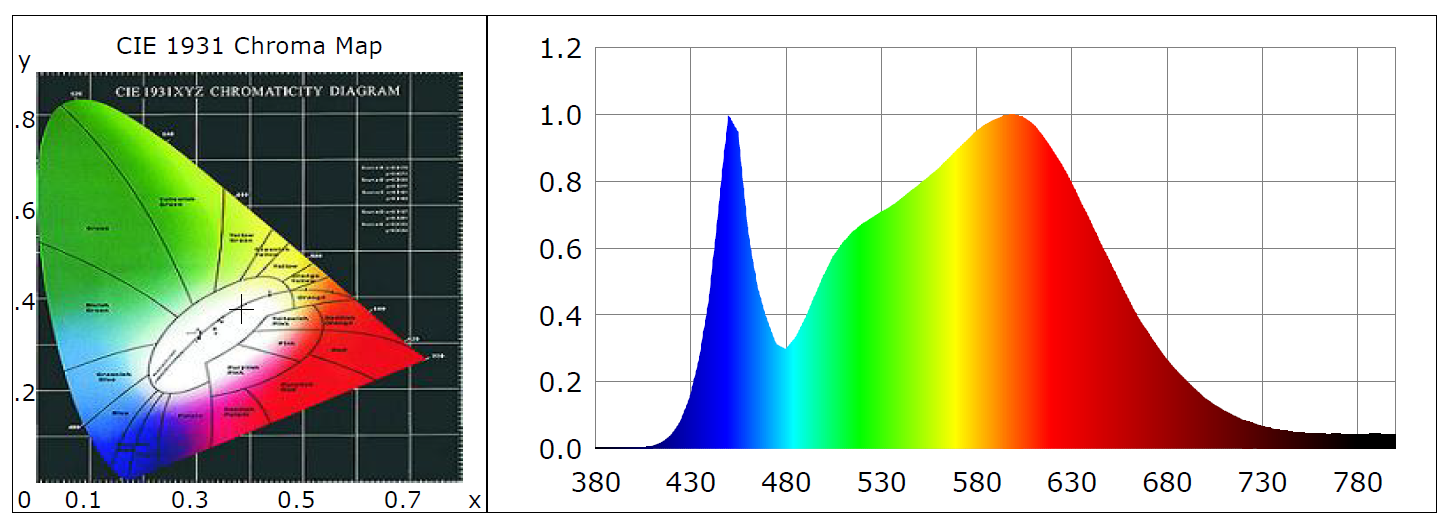
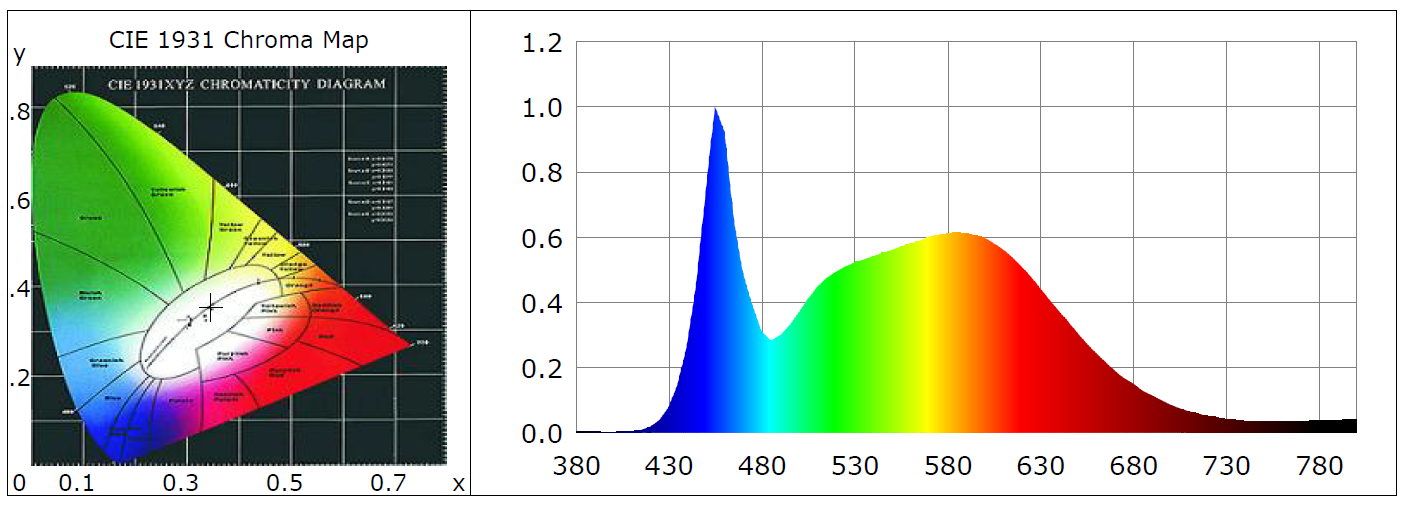
3. 6500K (Blue Dominant): The spectral graph features a towering spike at 455nm (deep blue), while the red and orange regions are noticeably lower. This closely mimics the intense, direct midday sunlight. It is ideal for medical laboratories, precision industrial inspection lines, warehouses, and other environments where high visual contrast and a vigilant operational state are essential.

How 4000K and 6500K Shape Perception and Performance
Visual Perception and Psychological Differences Between 4000K and 6500K
| Dimension | 4000K (Neutral White) | 6500K (Cool Daylight) |
|---|---|---|
| Visual Clarity | Softer edge definition; more comfortable for extended viewing. | High‑contrast rendering; fine text and intricate detail appear sharper. |
| Color Fidelity | Paired with CRI > 90, it reveals true‑to‑life colors — ideal for retail and premium interiors. | Even with high CRI, the strong blue cast can wash out warm tones, creating a “clinical” feel. |
| Psychological Cue | Focused, balanced, professional, and calm. | Alert, efficient, modern, and technology‑oriented. |
This is why 6500K often feels “brighter” even when lumen output is identical: its blue‑rich spectrum increases perceived contrast and visual acuity, making it the default for inspection or medical tasks. But for applications where accurate color matters — a high‑end showroom, an art gallery, a design studio — 4000K at 90+ CRI is the safer, more honest choice. It shows the object, not the light source.
Task‑Based Selection of Color Temperature
Within the same space, color temperature varies depending on the application. Consider a modern meeting room: a collaborative brainstorming session, where 4000K light fosters open communication, versus a detailed contract review one hour later, which demands 6500K for high‑definition clarity.
| Task Category | Recommended CCT | Why |
|---|---|---|
| High‑Alert Tasks (surgery, precision inspection, fast‑paced assembly) |
6500K | Research suggests this CCT maximizes cortisol‑driven alertness, reaction speed, and fine‑detail recognition. |
| Sustained Focus Tasks (coding, writing, financial analysis, general office work) |
4000K | Provides a balanced circadian signal — sharp enough for concentration, gentle enough to avoid long‑term fatigue. |
| Social & Experiential Tasks (retail browsing, dining, hotel lobby interaction) |
3000K/3500K | Creates a welcoming, true‑color environment that encourages comfort and trust. |
This task‑first logic holds for single‑function spaces. Explore our 4000K and 6500K commercial lighting series. But what if the same room needs to shift from focused work to collaboration to relaxation throughout the day — without changing fixtures? That’s where tunable white technology redefines the 4000K vs. 6500K debate.

The Future‑Ready Choice — From Static to Dynamic Lighting
What if the same room needs to deliver balanced focus at 4000K in the morning and high‑contrast precision at 6500K by early afternoon — without changing a single fixture? This is where tunable white LED technology turns the 4000K vs. 6500K debate into a single, flexible specification.
When You No Longer Have to Choose Between 4000K and 6500K
Tunable white fixtures integrate two or more LED chip sets — typically a warm channel (around 2700K) and a cool channel (around 6500K). By independently varying the drive current to each channel, the luminaire blends their output to produce any white point across the full color temperature range. The result is seamless, stepless adjustment from 2700K all the way to 6500K — all from a single housing.
More than a convenience, this is the hardware foundation of Human Centric Lighting (HCL). A tunable white system can be programmed to shift its color temperature automatically throughout the day, reinforcing the body’s natural circadian rhythm.
| Time of Day | CCT Setting | Light Signal & Effect |
|---|---|---|
| Early Morning (7:00–9:00) | 5000K–6500K | Energizing, high alertness — promotes cortisol and suppresses melatonin |
| Mid‑Morning to Afternoon (9:00–16:00) | 4000K | Balanced focus, sustained concentration without overstimulation |
| Late Afternoon (16:00–18:00) | 3000K–3500K | Gradual wind‑down, preparing the body for evening |
| Evening/Night (18:00+) | 2700K | Warm, calming — supports natural melatonin production |
Control protocols make this automation possible. The two most common in commercial specifications are compared below.
| Feature | DALI | 0–10V |
|---|---|---|
| Signal Type | Digital (bi‑directional) | Analog (unidirectional) |
| Individual Fixture Addressing | Yes | No |
| Dimming Precision | High (0.1% steps) | Moderate |
| Feedback from Fixture | Yes | No |
| Best For | Large‑scale commercial projects needing granular scene control | Simple, cost‑sensitive applications |
To fully realize the potential of dynamic color temperature in your space, view our tunable white lighting solutions.
How to Evaluate Color Temperature Quality from a Manufacturer
Whether your project specifies fixed 4000K, fixed 6500K, or a full tunable white system, one quality variable can silently destroy the visual result: inconsistent color from luminaire to luminaire. Two downlights in the same ceiling, identical on paper, can appear slightly green or pink — turning a premium installation into a patchwork ceiling.
This inconsistency is quantified by SDCM (Standard Deviation of Color Matching). It measures how far individual LEDs deviate from the target chromaticity. The lower the SDCM value, the tighter the consistency.
| SDCM Value | Visual Perception | Suitability |
|---|---|---|
| ≤ 2 | Virtually invisible difference | Premium architectural projects, museums, flagship retail |
| ≤ 3 | Undetectable to the human eye | Gold standard for commercial offices, healthcare, hospitality |
| ≤ 5 | Noticeable to a trained eye upon close inspection | Utility areas, storage, back‑of‑house |
| > 5 | Clearly visible color variation | Not recommended for any professional installation |

Learn about our high-color rendering commercial lighting series with an SDCM<3 to ensure perfect color consistency across your entire installation.
Summary: Your Step‑by‑Step Decision Checklist
You’ve seen the science, the spectral data, and the design strategies. Now use this interactive decision tree. Start at the top and answer each question — the path will lead you to the right color temperature and remind you about brightness, complexity, and final purchasing checks.
        START: Find Your Perfect Color Temperature
          │
          └─ What is the PRIMARY activity in this space?
               │
               ├── HIGH‑ALERT TASK (surgery, precision inspection, fast‑paced assembly)
               │     └─ ► Recommendation: 6500K
               │           └─ Check brightness: Is ambient illuminance high (>500 lux)?
               │                 ├─ YES → 6500K will feel crisp and comfortable.
               │                 └─ NO → 6500K may feel cold or eerie. Increase lux level to match.
               │
               ├── SUSTAINED FOCUS TASK (coding, writing, office work)
               │     └─ ► Recommendation: 4000K
               │           └─ Check brightness: Is the space reasonably bright (300–500 lux)?
               │                 ├─ YES → 4000K will deliver calm, long‑duration focus.
               │                 └─ NO → Boost general lighting to mid‑level; avoid dim 4000K.
               │
               └── SOCIAL / EXPERIENTIAL / RELAXATION TASK (retail, dining, lounge, gallery)
                     └─ ► Recommendation: 3000K–3500K
                           (Warmer CCTs build comfort and trust. High CRI is essential here.)
          │
          └─ Does the space need to support MULTIPLE activities at once, or change function throughout the day?
               │
               ├── YES → Consider mixed CCT zones or a tunable white (2700K-6500K) system.
               │
               └── NO → Stick with a single fixed CCT.
                     │
                     └─ FINAL PURCHASE CHECK:
                           ├─ Does the supplier guarantee SDCM ≤ 3 across batches?
                           ├─ Is the fixture rated at CRI > 90 for your application?
                           └─ Can they provide a test report (IES LM‑80, integrating sphere data)?
                                │
                                └─ YES to all → Proceed with confidence.
                                   Any NO → Request documentation or consider an alternative supplier.
Pro tip: Bookmark this decision tree. It turns a subjective “warm vs. cool” debate into a repeatable, defensible specification process — whether you’re outfitting a single office or an entire building.
Frequently Asked Questions About 4000K and 6500K
What is a tunable white LED, and how does it work?
A tunable white fixture contains at least two sets of LED chips — typically a warm-white channel (around 2700K) and a cool-white channel (around 6500K). By independently controlling the intensity of each channel, the fixture blends their output to produce any white point in between. The adjustment is smooth and stepless, and when paired with a DALI or 0-10V control system, it can be automated to follow a circadian schedule. One fixture, full-spectrum flexibility from sunrise warmth to midday precision.
What is tunable CCT and should I choose it over fixed 4000K or 6500K?
Tunable CCT fixtures allow the user to adjust color temperature across a range, typically 2700–6500K, using a control system. They offer maximum flexibility for multi-purpose spaces, circadian lighting schemes, and projects where the final use of the room may change. The trade-off is higher cost and more complex control infrastructure. For single-function spaces, a well-chosen fixed color temperature is more cost-effective.
Is 6500K brighter than 4000K?
Perceptually, yes, at equal lumen output. The stronger blue content in 6500K light stimulates the eye's photoreceptors more intensely, creating a sensation of greater brightness. Measured in lumens, however, the outputs can be identical; the difference is in visual perception, not radiometric power.
Does 6500K cause more eye strain than 4000K?
In prolonged exposure, 6500K can contribute to visual fatigue more than 4000K, particularly in screen-based work environments. The higher blue peak increases glare sensitivity and reduces blink rate over time. Proper optical design, indirect lighting components, and time-based dimming can mitigate these effects.
What color temperature is best for a home office?
4000K is the safest all-around choice. It provides clarity for paperwork and screen work without the harshness that 6500K can bring to a domestic setting. If the home office receives abundant natural daylight, 5000K can also work, but 4000K with a high-CRI fixture is the best default recommendation.
How can I tell if my LED's color temperature is accurate?
The most accessible method is visual comparison against a reference source of known color temperature, but this requires experience. A more objective approach is to request the manufacturer's integrating sphere test report, which measures actual CCT and SDCM for that specific fixture.
Why do offices in Europe prefer 3000K–4000K, while many Asian offices default to 5000K–6500K?
Based on our project experience and regional lighting standards, one widely accepted explanation lies in climate and culture. In Northern and Central Europe, where natural daylight is scarce for much of the year, warmer color temperatures (3000K–4000K) create a sense of indoor comfort and coziness — compensating for the grey, overcast skies outside. European lighting standards also matured early around incandescent and halogen aesthetics, embedding a cultural preference for warmth. In many parts of Asia and the Middle East, where bright sunlight is abundant year-round, higher CCTs (5000K–6500K) feel natural, modern, and synonymous with cleanliness and efficiency. Both preferences are valid; the takeaway is to design for occupant expectation and environmental context — not a single global template.
How long do 4000K and 6500K LEDs typically last?
Both are rated to L70 lifetimes of 50,000 hours or more when using quality mid-power or COB LEDs and properly designed thermal management. Lifespan is determined by junction temperature and driver quality, not by color temperature. Always ask for IES LM-80 test data and TM-21 projections that demonstrate lumen maintenance over time.
Discuss your project with our lighting specialists
Receive a tailored specification that matches your exact color temperature requirements — whether fixed 4000K, 6500K, or a full tunable white system.
Lumens to Watts: The Pro's Guide to Real Brightness
How Much Does Recessed Lighting Installation Cost ?
Related Article